Facebook is changing. Surely you've noticed. Your best friends are getting buried beneath memes; your mom is getting pushed aside by image spam. Your social graph is becoming secondary to your interest graph. Worried about competitors like Tumblr and Twitter, and urgently in need of new revenue flow following its rocky IPO, the biggest social network in the world is drifting away from its social core. Say hello to the new Facebook. You won't find many people here. But you will find a lot of trash.
Read more at the Daily Dot
Thursday, June 6
Wednesday, June 5
newspaper circulation rises in the east and falls in the west
THE World Press Trends report collects masses of data about newspaper circulation and revenues in over 70 countries. The report makes for particularly gloomy reading if you happen to be employed by a newspaper in America or western Europe.
Since 2008 circulation in America has fallen by 15% to 41m while advertising revenue has plummeted by 42%, accounting for three-quarters of the global decline in advertising revenue in the same period. In Europe, circulation and advertising revenue have both fallen by a quarter. And revenues from digital sources such as websites, apps and so on have not made up the shortfall. Digital advertising accounts for just 11% of the total revenue for American newspapers. Looking further east, though, things look brighter. Circulation in Asia has risen by 10%, offsetting much of the decline elsewhere. With 114.5m daily newspapers, China has surpassed India to become the world's biggest newspaper market.
Read more at The Economist
Since 2008 circulation in America has fallen by 15% to 41m while advertising revenue has plummeted by 42%, accounting for three-quarters of the global decline in advertising revenue in the same period. In Europe, circulation and advertising revenue have both fallen by a quarter. And revenues from digital sources such as websites, apps and so on have not made up the shortfall. Digital advertising accounts for just 11% of the total revenue for American newspapers. Looking further east, though, things look brighter. Circulation in Asia has risen by 10%, offsetting much of the decline elsewhere. With 114.5m daily newspapers, China has surpassed India to become the world's biggest newspaper market.
Read more at The Economist

Paywalls or No Paywalls, Newspaper Revenue Declines Seen Through 2017
Despite the promise of online paywalls and gains in digital readers, U.S. newspapers' total revenue will continue to decline through at least 2017, a new report said. Total U.S. newspaper revenue is projected to slip at a combined annual growth rate of 2.9% between 2013 and 2017, as circulation trends improve but advertising falls at a compound annual rate 4.2%, according to the latest annual Global Entertainment and Media Outlook from PricewaterhouseCoopers.
As more people go to newspaper websites, digital advertising is expected to increase through 2017, growing at a compound annual rate of 9.7% between 2013 and 2017, the report said. But the gains won’t be enough to offset the 7.8% compound annual decline in print ads.
Read more here
As more people go to newspaper websites, digital advertising is expected to increase through 2017, growing at a compound annual rate of 9.7% between 2013 and 2017, the report said. But the gains won’t be enough to offset the 7.8% compound annual decline in print ads.
Read more here
Sunday, June 2
The workforce in the cloud
Elance.com and oDesk.com (are) the two busiest among several newish online marketplaces for work, or “talent exchanges”. Last year the value of this sort of online work topped $1 billion for
the first time; it will double to $2 billion in 2014, and reach $5
billion by 2018, forecasts Staffing Industry Analysts, a “contingent
work” consultant.
There are other differences in the business models of the market leaders. oDesk simply takes a cut of all completed jobs; Elance also charges freelancers optional fees for extra services. Both have been trying to improve the quality of the reputation-rating system, and to ensure that work is being done by the person who accepted it rather than passed on to someone potentially less competent (“Still the biggest risk”).
Read more at The Eoncomist
There are other differences in the business models of the market leaders. oDesk simply takes a cut of all completed jobs; Elance also charges freelancers optional fees for extra services. Both have been trying to improve the quality of the reputation-rating system, and to ensure that work is being done by the person who accepted it rather than passed on to someone potentially less competent (“Still the biggest risk”).
Read more at The Eoncomist
Teaching old microphones new tricks
With the addition of suitable software, microphones can detect more than mere audio signals. They can act as versatile sensors, capable of tuning into signals from inside the body, assessing the social environment and even tracking people’s posture and gestures. Researchers have reimagined microphones as multi-talented collectors of information. And because they are built into smartphones that can be taken anywhere, and can acquire new abilities simply by downloading an app, they are being put to a range of unusual and beneficial uses.
Read more at the Economist
Read more at the Economist
Thursday, May 30
Amateur journalists create jobs for professional ones
Far from shunning “shaky footage”, audiences think users’ videos more intimate and authentic than broadcasters’ slick shots, says Claire Wardle of Storyful, a firm that spots and verifies user-generated content. “If they don’t show it, people will go to YouTube to see it.” Journalists covering big news stories are getting better at scouring social networks for sources. And thrusting news firms have tried to outdo their competitors by building systems that encourage readers to submit material to them directly.
Investigative journalists are making better use of amateur sleuths by requesting documents, testimonials and a spare hand. Every journalist needs help shovelling for dirt.
Read more at The Economist
Investigative journalists are making better use of amateur sleuths by requesting documents, testimonials and a spare hand. Every journalist needs help shovelling for dirt.
Read more at The Economist
Wednesday, May 29
Technology forecasting
Scorn the latest advances and you risk being left behind, as when Sony kept investing in flat-screen versions of cathode-ray televisions in the 1990s while Samsung piled into liquid-crystal displays (LCDs), and eventually replaced Sony as market leader. Embrace new ideas too early, though, and you may be left with egg on your face, as when General Motors spent more than $1 billion developing hydrogen fuel cells a decade ago, only to see them overtaken by lithium-ion batteries as the preferred power source for electric and hybrid vehicles.
To determine when to proceed with a new technology many managers and engineers employ popular heuristics, some of which are seen as “laws”. The best known is Moore’s law.
In reality, however, such laws are unreliable because progress is rarely smooth. So Ashish Sood of the Goizueta School of Business at Emory University, Atlanta, and his colleagues have come up with their own law, which is explicitly based on the tendency of technology to progress in stops and starts. As the number of competitors in a new field increases, both the size of the steps and the length of the wait for the next step can change.
Their “step and wait” (SAW) model, recently published in Marketing Science, notes that advances in performance are often followed by a waiting period before the next step forward.
Read more at The Economist
To determine when to proceed with a new technology many managers and engineers employ popular heuristics, some of which are seen as “laws”. The best known is Moore’s law.
In reality, however, such laws are unreliable because progress is rarely smooth. So Ashish Sood of the Goizueta School of Business at Emory University, Atlanta, and his colleagues have come up with their own law, which is explicitly based on the tendency of technology to progress in stops and starts. As the number of competitors in a new field increases, both the size of the steps and the length of the wait for the next step can change.
Their “step and wait” (SAW) model, recently published in Marketing Science, notes that advances in performance are often followed by a waiting period before the next step forward.
Read more at The Economist
Sunday, May 26
A plan to assess people’s personal characteristics from their Twitter-streams
Modern psychology recognises five dimensions of personality: extroversion, agreeableness, conscientiousness, neuroticism and openness to experience. Previous research has shown that people’s scores on these traits can, indeed, predict what they purchase. Extroverts are more likely to respond to an advert for a mobile phone that promises excitement than one that promises convenience or security. They also prefer Coca-Cola to Pepsi and Maybelline cosmetics to Max Factor. Agreeable people, though, tend to prefer Pepsi, and those open to experience prefer Max Factor.
People are, of course, unlikely to want to take personality tests so that marketing departments around the world can intrude even more on their lives than happens already. But Dr Haber thinks he can get around that—at least for users of Twitter. He and his team have developed software that takes streams of “tweets” from this social medium and searches them for words that indicate a tweeter’s personality, values and needs.
For a study published in 2010 by Tal Yarkoni of the University of Colorado, Boulder, Dr Yarkoni recruited a group of bloggers and correlated the frequencies of certain words and categories of word that they used in their blogs with their personality traits, as established by questionnaire.
Some of the relations he found were commonsensical. Extroversion correlated with “bar”, “restaurant” and “crowd”. Neuroticism correlated with “awful”, “lazy” and “depressing”. But there were also unforeseen patterns. Trust (an important component of agreeableness), for example, correlated with “summer”, and co-operativeness (another element of agreeableness) with “unusual”.
Inspired by Dr Yarkoni’s findings, Dr Eben Haber and his team are conducting research of their own, matching word use with two sets of traits not directly related to personality. These are people’s values (things they deem to be good, beneficial and important, such as loyalty, accuracy and self-enhancement) and their needs (things they feel they cannot live without, such as excitement, control or acceptance).
In a test of the new system, Dr Haber analysed three months’ worth of data from 90m users of Twitter. His software was able to parse someone’s presumptive personality reasonably well from just 50 tweets, and very well indeed from 200.
Read more at The Economist
For a study published in 2010 by Tal Yarkoni of the University of Colorado, Boulder, Dr Yarkoni recruited a group of bloggers and correlated the frequencies of certain words and categories of word that they used in their blogs with their personality traits, as established by questionnaire.
Some of the relations he found were commonsensical. Extroversion correlated with “bar”, “restaurant” and “crowd”. Neuroticism correlated with “awful”, “lazy” and “depressing”. But there were also unforeseen patterns. Trust (an important component of agreeableness), for example, correlated with “summer”, and co-operativeness (another element of agreeableness) with “unusual”.
Inspired by Dr Yarkoni’s findings, Dr Eben Haber and his team are conducting research of their own, matching word use with two sets of traits not directly related to personality. These are people’s values (things they deem to be good, beneficial and important, such as loyalty, accuracy and self-enhancement) and their needs (things they feel they cannot live without, such as excitement, control or acceptance).
In a test of the new system, Dr Haber analysed three months’ worth of data from 90m users of Twitter. His software was able to parse someone’s presumptive personality reasonably well from just 50 tweets, and very well indeed from 200.
Read more at The Economist
Video games Battle of the boxes
VIDEO games are big money-spinners. According to DFC Intelligence, a market-research firm, the industry was worth almost $80 billion in 2012 (combining software, gaming revenue and devices), or roughly the same as the film industry’s takings. Although gaming on smartphones, tablets and social-networking sites is growing fast, dedicated games consoles still dominate the business.
Read more at the Economist
Read more at the Economist
Friday, May 24
How Teens Are Really Using Facebook: It's a 'Social Burden,' Pew Study Finds
The Facebook generation is fed up with Facebook. That's according to a report released Tuesday by the Pew Research Center. Pew's findings suggest teens' enthusiasm for Facebook is waning, lending credence to concerns, raised by the company's investors and others that the social network may be losing a crucial demographic that has long fueled its success.
Facebook has become a "social burden" for teens, write the authors of the Pew report. "While Facebook is still deeply integrated in teens’ everyday lives, it is sometimes seen as a utility and an obligation rather than an exciting new platform that teens can claim as their own."
Teen's aren't abandoning Facebook -- deactivating their accounts would mean missing out on the crucial social intrigues that transpire online -- and 94 percent of teenage social media users still have profiles on the site, Pew's report notes. But they're simultaneously migrating to Twitter and Instagram, which teens say offer a parent-free place where they can better express themselves. Facebook, teens say, has been overrun by parents, fuels unnecessary social "drama" and gives a mouthpiece to annoying oversharers who drone on about inane events in their lives.
Read more at Huff Post
Facebook has become a "social burden" for teens, write the authors of the Pew report. "While Facebook is still deeply integrated in teens’ everyday lives, it is sometimes seen as a utility and an obligation rather than an exciting new platform that teens can claim as their own."
Teen's aren't abandoning Facebook -- deactivating their accounts would mean missing out on the crucial social intrigues that transpire online -- and 94 percent of teenage social media users still have profiles on the site, Pew's report notes. But they're simultaneously migrating to Twitter and Instagram, which teens say offer a parent-free place where they can better express themselves. Facebook, teens say, has been overrun by parents, fuels unnecessary social "drama" and gives a mouthpiece to annoying oversharers who drone on about inane events in their lives.
Read more at Huff Post
Thursday, May 23
Video Games: suffering industry
Sales figures are murky, but most estimates put annual revenues (for video games) at between $60 billion and $70 billion.
According to NPD, a firm of analysts, sales of consoles and other hardware fell by a fifth in America last year. Sales of the games themselves are doing no better. Both Sony and Microsoft, which makes the Xbox, a rival line of consoles, have reported falling income from their games divisions.
Games designed for smartphones and tablets are booming. In 2012 the ten top-grossing apps for Apple’s iPhone smartphone were all games. Many mobile games are free; those that are not sell for a handful of dollars compared with $60 for a big-budget console title.
Read more here
According to NPD, a firm of analysts, sales of consoles and other hardware fell by a fifth in America last year. Sales of the games themselves are doing no better. Both Sony and Microsoft, which makes the Xbox, a rival line of consoles, have reported falling income from their games divisions.
Games designed for smartphones and tablets are booming. In 2012 the ten top-grossing apps for Apple’s iPhone smartphone were all games. Many mobile games are free; those that are not sell for a handful of dollars compared with $60 for a big-budget console title.
Read more here
Newspaper, Magazine Ad Fortunes Continue To Decline
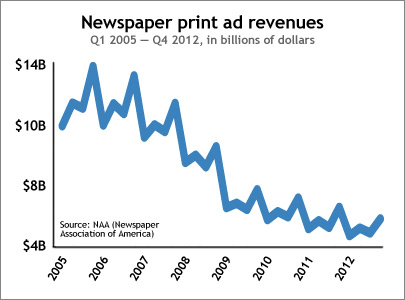
The release of fourth-quarter figures for newspaper advertising and first-quarter figures for magazine ad pages earlier this month made it clear that the long decline of print advertising is going to continue -- and possibly even accelerate -- in coming years.
Print advertising has suffered a precipitous 60% drop over just seven years, with 27 straight quarters of year-over-year declines. This is the seventh straight quarter of year-over-year declines for magazines, wiping out the short-lived recovery enjoyed by the medium in 2010. Magazine ad pages tumbled from a total of 243,305 in 2005 to 150,699 in 2012, for a 38% decline over the last seven years.
 Read more here
Print advertising has suffered a precipitous 60% drop over just seven years, with 27 straight quarters of year-over-year declines. This is the seventh straight quarter of year-over-year declines for magazines, wiping out the short-lived recovery enjoyed by the medium in 2010. Magazine ad pages tumbled from a total of 243,305 in 2005 to 150,699 in 2012, for a 38% decline over the last seven years.
Read more here
Tuesday, May 21
A tale of two Tinseltowns
“The business model within film is broken,” says Amir Malin of Qualia Capital, a private-equity firm. Between 2007 and 2011, pre-tax profits of the five studios controlled by large media conglomerates (Disney, Universal, Paramount, Twentieth Century Fox and Warner Bros) fell by around 40%, says Benjamin Swinburne of Morgan Stanley. He reckons the studios account for less than 10% of their parent companies’ profits today, and by 2020 their share will decline to only around 5%. That is because the “big six” studios (the other is Sony Pictures, owned by the eponymous electronics maker) are growing more slowly than TV.
Film and TV are very different businesses, though studios like Warner Bros and Fox do both. TV is relatively stable and currently lucrative. In contrast, film revenues are volatile. In 2011 American cinemas sold 1.28 billion tickets, the smallest number since 1995. Last year, ticket sales rose back to 1.36 billion and box-office revenues to a record $10.8 billion, thanks to blockbusters like “The Avengers”. But film-going in America is not a growth business, especially now that people have so many media to distract them at home. The share of Americans who attend a cinema at least once a month declined from 30% in 2000 to 10% in 2011.
One boss of a film-production company calls the international box office “the lifeboat on the Titanic”. Box-office revenues outside America are growing two and a half times as fast as they are domestically.
Read more here
Film and TV are very different businesses, though studios like Warner Bros and Fox do both. TV is relatively stable and currently lucrative. In contrast, film revenues are volatile. In 2011 American cinemas sold 1.28 billion tickets, the smallest number since 1995. Last year, ticket sales rose back to 1.36 billion and box-office revenues to a record $10.8 billion, thanks to blockbusters like “The Avengers”. But film-going in America is not a growth business, especially now that people have so many media to distract them at home. The share of Americans who attend a cinema at least once a month declined from 30% in 2000 to 10% in 2011.
One boss of a film-production company calls the international box office “the lifeboat on the Titanic”. Box-office revenues outside America are growing two and a half times as fast as they are domestically.
Read more here
How to Buy Friends and Influence People on Facebook
Whoever said you can’t buy friends was dead wrong. A search for “Twitter followers” reveals dozens of outfits dedicated to making insecure weirdos (and marketers) with cash to burn look more popular than they are. To game the system, these companies create fake users and even pay real account holders for following and liking. As a result, the social media giants must constantly tweak their algorithms to spot frauds; recent upgrades to Facebook’s auto-detection system resulted in accounts losing thousands of likes. Here’s our guide to the not-so-underground friend market.
Facebook
Price of popularity: On Socialyup.com you can buy 500 likes for $30 or 20,000 for $699.
Spot the frauds: Watch for accounts with lots of likes but very little discernible user activity. A page with tens of thousands of fans but only a few comments and nobody in the “Talking About This” column is a prime suspect. One study says 97 percent of fake profiles identify themselves as female (while just 40 percent of real users do).
Pinterest
Price of popularity: Pinfol delivers 100 followers for $15 or 5,000 for $95.
Spot the frauds: Scroll through a user’s followers list and keep an eye out for a high proportion of accounts with no bio or photo.
Twitter
Price of popularity: FanMeNow’s packages start at $10 for 1,000 followers. $1,750 will score you a million.
Spot the frauds: Promotional tweets and the default “egg” avatar are hallmarks of phony accounts. Fake Follower Check is a free web tool that measures a user’s followers against typical characteristics of spam accounts.
YouTube
Price of popularity: 500views.com delivers 30,000 views for $150. For $3,100, make your video “viral” with a million views.
Spot the frauds: Beware of generic comments. One music clip we saw racked up tens of thousands of views in weeks, but the only comments were variations on “This video is great!”
Read more here
Price of popularity: On Socialyup.com you can buy 500 likes for $30 or 20,000 for $699.
Spot the frauds: Watch for accounts with lots of likes but very little discernible user activity. A page with tens of thousands of fans but only a few comments and nobody in the “Talking About This” column is a prime suspect. One study says 97 percent of fake profiles identify themselves as female (while just 40 percent of real users do).
Price of popularity: Pinfol delivers 100 followers for $15 or 5,000 for $95.
Spot the frauds: Scroll through a user’s followers list and keep an eye out for a high proportion of accounts with no bio or photo.
Price of popularity: FanMeNow’s packages start at $10 for 1,000 followers. $1,750 will score you a million.
Spot the frauds: Promotional tweets and the default “egg” avatar are hallmarks of phony accounts. Fake Follower Check is a free web tool that measures a user’s followers against typical characteristics of spam accounts.
YouTube
Price of popularity: 500views.com delivers 30,000 views for $150. For $3,100, make your video “viral” with a million views.
Spot the frauds: Beware of generic comments. One music clip we saw racked up tens of thousands of views in weeks, but the only comments were variations on “This video is great!”
Read more here
Monday, May 20
Thanks to new digital tools, marketing is no longer voodoo
Give and take has “radically changed the relationship between our brands and the consumer”, says Patrice Bula, Nestlé’s marketing chief. “Today we have really entered the age of conversation.”
This helps explain why marketers are feeling both potent and panicky. Instead of just lobbing messages out into the void, they must now act as customers’ “ambassadors”, says David Edelman of McKinsey, a consultancy. And that is tricky. Already 70% of big American firms employ a “chief marketing technologist.”
Read more here
Read more here
On YouTube, Video Makes the Radio Star
Since YouTube’s inception in 2005, the site’s been known primarily as a bottomless Big Gulp brimming with webcam confessionals, cute-mammal footage, and assorted other Web junk. Over time it’s also become a musical kingmaker—a place where fledgling and unfamiliar talent can break through to massive audiences.
A decade ago the record industry’s gears clicked along more or less as they always had: Labels signed up promising acts discovered by A&R scouts, paid those acts advances against future music sales, and hawked that music through a sprawling network of radio programmers and retailers. Today, with album sales continuing to plummet—in 2004, 666.7 million albums were sold; by 2012 that number was down more than 50 percent, to 316 million—labels and artists depend more than ever on touring and merchandise for revenue. Songs are ads meant to help sell tickets and T-shirts, and YouTube is beginning to rival radio when it comes to breaking those tracks.
Read more here
A decade ago the record industry’s gears clicked along more or less as they always had: Labels signed up promising acts discovered by A&R scouts, paid those acts advances against future music sales, and hawked that music through a sprawling network of radio programmers and retailers. Today, with album sales continuing to plummet—in 2004, 666.7 million albums were sold; by 2012 that number was down more than 50 percent, to 316 million—labels and artists depend more than ever on touring and merchandise for revenue. Songs are ads meant to help sell tickets and T-shirts, and YouTube is beginning to rival radio when it comes to breaking those tracks.
Read more here
Friday, May 17
Ethics Flags For New Media
Launching his namesake company's news division in the 1990s, Michael Bloomberg largely rejected long-held rules of the journalism trade that insist on keeping thick firewalls between reporters and the profit-making workings of their companies.
Companies like Bloomberg are reinventing the news business. And it raises key questions for people who watch the media, most notably this one: As the news business gets reconfigured around advances in technology, what does that mean for the old rules and the people who follow them?
"Many more journalism companies will face the type of competing values that the journalists at Bloomberg faced because, as the economic model for journalism changes, more companies, if they're successful, are going to look like Bloomberg," said Kelly McBride, who teaches journalism ethics at The Poynter Institute.
Read more here
Companies like Bloomberg are reinventing the news business. And it raises key questions for people who watch the media, most notably this one: As the news business gets reconfigured around advances in technology, what does that mean for the old rules and the people who follow them?
"Many more journalism companies will face the type of competing values that the journalists at Bloomberg faced because, as the economic model for journalism changes, more companies, if they're successful, are going to look like Bloomberg," said Kelly McBride, who teaches journalism ethics at The Poynter Institute.
Read more here
Media Balks at Band-Aid Shield Law
49 states plus the District of Columbia have some form of shield law giving journalists a degree of confidentiality similar to that which prevents priests, attorneys, and therapists from testifying in court. But the law has failed to gain traction at the federal level, partially due to indifference outside the media industry, and partially due to concerns that the law would hinder criminal and national security investigations.
Read more here.
Read more here.
Thursday, May 16
Monday, May 6
Radio Dips, But Station, Digital Revs Rise
Clear Channel said total revenues slipped 1% from $1.36 billion in the first quarter of 2012 to $1.34 billion in the first quarter of 2013, due to declines in its radio and international outdoor business. These losses were offset somewhat by increases in its Americas outdoor division.
Read more here
Read more here
Wednesday, May 1
Facebook Ad Revs Skyrocket 43%, Mobile Grows To 30%
Facebook is looking more than ever like the mobile company CEO Mark Zuckerberg declared it had become last year. The social network's mobile business rose to 30% of its advertising sales in the first quarter from almost nothing a year ago.
Why Facebook is focusing so keenly on mobile is no mystery. Facebook said its number of monthly active mobile users hit 751 million as of the end of March, up 54% from a year ago, and up 10% from 680 million in the fourth quarter. Monthly active users on Facebook overall reached 1.1 billion, up 23% from a year ago, while daily active users rose 26% to 665 million in the quarter.
Read more here
Why Facebook is focusing so keenly on mobile is no mystery. Facebook said its number of monthly active mobile users hit 751 million as of the end of March, up 54% from a year ago, and up 10% from 680 million in the fourth quarter. Monthly active users on Facebook overall reached 1.1 billion, up 23% from a year ago, while daily active users rose 26% to 665 million in the quarter.
Read more here
Tuesday, April 30
Twenty Years Ago Today the World Wide Web Went Public
Twenty years ago today, something happened that changed the digital world forever: CERN published a statement that made the technology behind the World Wide Web available to use, by anybody, on a royalty free basis.
Read more at Gizmodo
Read more at Gizmodo
Sunday, April 21
Print v Digital Reading
How exactly does the technology we use to read change the way we read? How reading on screens differs from reading on paper is relevant not just to the youngest among us, but to just about everyone who reads—to anyone who routinely switches between working long hours in front of a computer at the office and leisurely reading paper magazines and books at home; to people who have embraced e-readers for their convenience and portability, but admit that for some reason they still prefer reading on paper; and to those who have already vowed to forgo tree pulp entirely. As digital texts and technologies become more prevalent, we gain new and more mobile ways of reading—but are we still reading as attentively and thoroughly? How do our brains respond differently to onscreen text than to words on paper? Should we be worried about dividing our attention between pixels and ink or is the validity of such concerns paper-thin?
Even so, evidence from laboratory experiments, polls and consumer reports indicates that modern screens and e-readers fail to adequately recreate certain tactile experiences of reading on paper that many people miss and, more importantly, prevent people from navigating long texts in an intuitive and satisfying way. In turn, such navigational difficulties may subtly inhibit reading comprehension. Compared with paper, screens may also drain more of our mental resources while we are reading and make it a little harder to remember what we read when we are done. A parallel line of research focuses on people's attitudes toward different kinds of media. Whether they realize it or not, many people approach computers and tablets with a state of mind less conducive to learning than the one they bring to paper.
At least a few studies suggest that by limiting the way people navigate texts, screens impair comprehension.
More at Scientific American here
Even so, evidence from laboratory experiments, polls and consumer reports indicates that modern screens and e-readers fail to adequately recreate certain tactile experiences of reading on paper that many people miss and, more importantly, prevent people from navigating long texts in an intuitive and satisfying way. In turn, such navigational difficulties may subtly inhibit reading comprehension. Compared with paper, screens may also drain more of our mental resources while we are reading and make it a little harder to remember what we read when we are done. A parallel line of research focuses on people's attitudes toward different kinds of media. Whether they realize it or not, many people approach computers and tablets with a state of mind less conducive to learning than the one they bring to paper.
At least a few studies suggest that by limiting the way people navigate texts, screens impair comprehension.
More at Scientific American here
Friday, April 19
YouTube Wins Copyright Battle With Viacom
A federal judge has cleared YouTube of liability for infringing copyright by allegedly hosting tens of thousands of clips of content owned by Viacom. U.S. District Court Judge Louis Stanton ruled that Google's YouTube was protected by the “safe harbor” provisions of the Digital Millennium Copyright Act, which broadly give sites immunity when users upload copyrighted material, as long as the sites remove the content upon request.
The ruling marks the second time that Stanton dismissed Viacom's case, which the company filed in 2007.
A Viacom spokesperson said the company intends to appeal the dismissal.
Read more here
The ruling marks the second time that Stanton dismissed Viacom's case, which the company filed in 2007.
A Viacom spokesperson said the company intends to appeal the dismissal.
Read more here
Thursday, April 18
AP makes its money from broadcasters
The Associated Press’ president and CEO says U.S. newspapers comprise only about 20% of its current revenue (and) broadcasters now provided the bulk of the organization’s revenue at about 43%.
http://www.netnewscheck.com/article/25661/ap-head-alliance-with-papers-is-beyond-biz
http://www.netnewscheck.com/article/25661/ap-head-alliance-with-papers-is-beyond-biz
Friday, April 12
Ad revenue uptick for print mags in 1st Q
Print magazines saw a 0.5% lift in advertising revenue in the first quarter, to $4.13 billion from $4.11 billion in the first quarter of 2012, according to the latest report from the Publishers Information Bureau (PIB). Ad pages declined 4.8% to 31,137 in the first quarter from 32,708 a year earlier. It was the first gain in almost two years.
More here
More here
Wednesday, April 10
Google Turns to Big Data to Unmask Human Traffickers
Despite all their manpower, law enforcement, anti-trafficking task forces, and policymakers know surprisingly little about the illegal cross-border flow of humans forced into the sex trade or into slave labor or cut open to have their organs extracted. Google (GOOG) believes Big Data can turn the tables on these crime gangs.
The search giant announced on April 9 that it will award a $3 million grant, part of its Global Impact Award program run through its Google Giving philanthropic arm, to a trio of anti-trafficking organizations.
Crunching data like this, and being able to match it with similar data across borders from other trafficking emergency hotlines, could build a clearer, more timely picture of where the human-trafficking-related crime is originating and how law enforcement and victims rights groups can intervene.
Read more at Business Week
The search giant announced on April 9 that it will award a $3 million grant, part of its Global Impact Award program run through its Google Giving philanthropic arm, to a trio of anti-trafficking organizations.
Crunching data like this, and being able to match it with similar data across borders from other trafficking emergency hotlines, could build a clearer, more timely picture of where the human-trafficking-related crime is originating and how law enforcement and victims rights groups can intervene.
Read more at Business Week
Pandora Hits 200 Million Users
Pandora has announced hitting the 200 million user mark in the U.S. The online radio service streams 200 million songs before 10 a.m. every day.
Read more here.
Read more here.
Monday, April 8
Newspaper Ad Revs Drop Again
Newspaper advertising revenues have been dropping steadily for some years now, and the end of 2012 brought no respite for publishers. For the full year, total ad revenues -- including niche publications, direct marketing and nondaily publication advertising -- fell 6.5% from $27.1 billion in 2011 to $25.3 billion in 2012. Focusing on the combined Sunday and daily ad revenues, including both print and online, total revenues slipped 6.8% from $23.9 billion to $22.3 billion. The latter figure is just 45% of peak newspaper revenues of $49.4 billion in 2005, equaling a 55% decline in seven years.
Read more here
Read more here
Magazine Ad Pages Slip
Print advertising is dwindling at consumer magazines. The Publishers Information Bureau released figures showing total magazine ad pages fell 4.9% from 33,673 in the first quarter of 2012 to 32,023 in the first quarter of 2013. Of 213 titles tracked by the PIB, 107 (50%) experienced ad page declines in the first quarter of 2013 compared to the same period in 2012.
Read more here.
Read more here.
How paywalls are evolving
It’s often easier to persuade people to subscribe to sports content than to entertainment content, even as it’s easier to sell ads against entertainment content than it is against sports content. So it does make sense to keep entertainment free, and put some kind of paywall around sports.
What’s impossible to calculate, of course, is the long-term opportunity cost of driving away people who want to read your content but aren’t willing to pay...the act of putting up a paywall is the act of “essentially harvesting revenue from a loyal long-term audience” — people who have been reading the publication for years, and have turned it into a habit they don’t want to give up. That’s fine, as a short-term means of maximizing revenues. But it’s dangerous in terms of getting new loyal readers. Which is one reason why online media startups almost never have paywalls: they want as many people as possible to discover them.
My expectation, then, is that newspaper paywalls will become both increasingly sophisticated and increasingly expensive over time — but that paywalls are not going to migrate very quickly out of the newspaper world and onto the rest of the internet. In a dying industry, the sensible thing to do is to maximize your revenues before you die. Paywalls might well make money for newspapers. But that doesn’t mean that newspapers aren’t dying. Quite the opposite.
Read more at Reuters
What’s impossible to calculate, of course, is the long-term opportunity cost of driving away people who want to read your content but aren’t willing to pay...the act of putting up a paywall is the act of “essentially harvesting revenue from a loyal long-term audience” — people who have been reading the publication for years, and have turned it into a habit they don’t want to give up. That’s fine, as a short-term means of maximizing revenues. But it’s dangerous in terms of getting new loyal readers. Which is one reason why online media startups almost never have paywalls: they want as many people as possible to discover them.
My expectation, then, is that newspaper paywalls will become both increasingly sophisticated and increasingly expensive over time — but that paywalls are not going to migrate very quickly out of the newspaper world and onto the rest of the internet. In a dying industry, the sensible thing to do is to maximize your revenues before you die. Paywalls might well make money for newspapers. But that doesn’t mean that newspapers aren’t dying. Quite the opposite.
Read more at Reuters
Saturday, April 6
EC says corporate information can be spread on Twitter, Facebook
The Securities and Exchange Commission says companies can use social media such as Facebook and Twitter to disseminate key information just as they already do on corporate websites. But, the agency said, companies must make it clear that they plan to make that information available on social media outlets so that investors know where to look for it.
Read more at the LA Times.
Read more at the LA Times.
Friday, April 5
Is The Company Behind Rodman's Korea Visit The Future Of Media?
What has become the core of the Vice brand is a kind of gritty, on-the-ground reporting from some of the roughest parts of the world.With Vice on track to expand to more countries and launch a news channel for young people, it may have inadvertently built the future of media.
Read (or listen) to more at NPR
Read (or listen) to more at NPR
Monday, April 1
Signs of promise and peril for American news organisations
Nearly a third of them say they have abandoned a news source because they thought the quality of its information was declining. Weather, traffic and sport now account for around 40% of local television newscasts. The average length of a story keeps falling. Only 20% of local TV stories exceed a minute, and half take less than 30 seconds.
A more pernicious trend is the growing number of public-relations workers. In 1980 PR flaks and journalists prowled in around equal numbers; in 2008 the ratio of PR folk to journalists was nearly four to one.
The bulk of the $37.3 billion spent on digital advertising in 2012 went to five firms: Google, Yahoo, Facebook, Microsoft and AOL.
Read more in the Economist
A more pernicious trend is the growing number of public-relations workers. In 1980 PR flaks and journalists prowled in around equal numbers; in 2008 the ratio of PR folk to journalists was nearly four to one.
The bulk of the $37.3 billion spent on digital advertising in 2012 went to five firms: Google, Yahoo, Facebook, Microsoft and AOL.
Read more in the Economist
Why data without a soul is meaningless
The problem with data is that the way it is used today, it lacks empathy and emotion. Data is used like a blunt instrument, a scythe trying to cut and tailor a cashmere sweater.
The idea of combining data, emotion and empathy as part of a narrative is something every company — old, new, young and mature — has to internalize. If they don’t, they will find themselves on the wrong side of history.
“Data needs stories, but stories also need data. Data, when its put up in front of you as a number, it gets stripped of the context of where the data came from, the biases inherent in it, and the assumptions of the models that created it.”
The symbiotic relationship between data and storytelling is going to be one of the more prevalent themes for the next the few years, starting perhaps inside some apps and in the news media.
Read more at Gigaomo
The idea of combining data, emotion and empathy as part of a narrative is something every company — old, new, young and mature — has to internalize. If they don’t, they will find themselves on the wrong side of history.
“Data needs stories, but stories also need data. Data, when its put up in front of you as a number, it gets stripped of the context of where the data came from, the biases inherent in it, and the assumptions of the models that created it.”
The symbiotic relationship between data and storytelling is going to be one of the more prevalent themes for the next the few years, starting perhaps inside some apps and in the news media.
Read more at Gigaomo
Sunday, March 31
Evernote's Cult Grows
That’s a lot of expectations for an experience that boils down to three columns in a browser window. You type, or clip or upload a new “note” (an image, a recording, or a Web page) into the right-hand column; store it in a “notebook” listed on the left-hand side; and browse or search in the middle. The promise is that Evernote saves your ideas, documents your meetings, archives articles, reminds you what your kid wants for Christmas, and coughs up the business card of Plaid Jacket Guy from that conference in Scottsdale. In addition to segregating such material into notebooks, users can organize it with tags, but don’t have to. Evernote’s search function, with optical character recognition that even picks up words within pictures, is impressively accurate and speedy. The effectiveness of this function is crucial, because the willingness to dump work and personal material in one place is central to Evernote’s worldview.
Evernote says it has 50 million users around the world (a third in the U.S.) and is adding 100,000 a day. Operating on a “freemium” model, the company makes money primarily from the sliver of that user base that pays $45 a year, or $5 a month, for a souped-up version with more storage capacity. It has been profitable, and though it’s investing heavily now, it expects to be profitable again soon. But with $251 million in venture backing and a valuation estimated at $1 billion, Evernote has greater ambitions. Chief Executive Officer Phil Libin talks about reaching a billion users; others at the company freely throw around the phrase “the Evernote lifestyle.”
Read more at Business Week
Evernote says it has 50 million users around the world (a third in the U.S.) and is adding 100,000 a day. Operating on a “freemium” model, the company makes money primarily from the sliver of that user base that pays $45 a year, or $5 a month, for a souped-up version with more storage capacity. It has been profitable, and though it’s investing heavily now, it expects to be profitable again soon. But with $251 million in venture backing and a valuation estimated at $1 billion, Evernote has greater ambitions. Chief Executive Officer Phil Libin talks about reaching a billion users; others at the company freely throw around the phrase “the Evernote lifestyle.”
Read more at Business Week
This Is the Scariest Statistic About the Newspaper Business Today
In 2012, newspapers lost $16 in print ads for every $1 earned in digital ads. And it's getting worse, according to a new report by Pew. In 2011, the ratio was just 10-to-1. Since 2003, print ads have fallen from $45 billion to $19 billion. Online ads have only grown from $1.2 to $3.3 billion. Stop and think about that gap. The total ten-year increase in digital advertising isn't even enough to overcome the average single-year decline in print ads since 2003.
Read more from The Atlantic
Read more from The Atlantic
Saturday, March 30
the Publishing Company That Beat the Internet
With the advent of the Internet, the primary sources of revenue—circulation and advertising—have eroded, while the costs of printing magazines—ink, paper, and distribution—continue to rise.
(But) Meredith, the demure Iowa-based publisher of upbeat women’s service magazines (including Better Homes and Gardens, Ladies’ Home Journal, and Traditional Home, has profited from a few key strategies. They are experts at repurposing their content across multiple platforms (magazines, books, websites, mobile devices, tablets, etc.) and aggressively look beyond advertising and circulation for revenue. In print, they stay as far away from the news as possible. They are particularly successful at licensing their magazine titles’ names to major national businesses selling branded products; they also run their own marketing agency.
Advertising remains the company’s lifeblood. In 2012 ad sales accounted for $769.8 million of Meredith’s $1.37 billion of revenue. Of that, 64 percent came from the company’s publishing division. The rest came from ad sales at Meredith’s 13 regional TV stations.
Read more at Business Week
(But) Meredith, the demure Iowa-based publisher of upbeat women’s service magazines (including Better Homes and Gardens, Ladies’ Home Journal, and Traditional Home, has profited from a few key strategies. They are experts at repurposing their content across multiple platforms (magazines, books, websites, mobile devices, tablets, etc.) and aggressively look beyond advertising and circulation for revenue. In print, they stay as far away from the news as possible. They are particularly successful at licensing their magazine titles’ names to major national businesses selling branded products; they also run their own marketing agency.
Advertising remains the company’s lifeblood. In 2012 ad sales accounted for $769.8 million of Meredith’s $1.37 billion of revenue. Of that, 64 percent came from the company’s publishing division. The rest came from ad sales at Meredith’s 13 regional TV stations.
Read more at Business Week
Friday, March 29
Mobile Users Check for Updates 14 Times a Day
Facebook mobile users check their smartphones for updates an average of 14 times a day, according to a survey by the social networking site and IDC on their mobile users. Facebook is the third-most used application on mobile phone devices, right after email (78 percent) and web browsing (73 percent).
At least 89 percent of 18-24 year olds surveyed check their smartphones within 15 minutes of waking up and 62 percent check their smartphones as soon as they wake up.
Read more here.
At least 89 percent of 18-24 year olds surveyed check their smartphones within 15 minutes of waking up and 62 percent check their smartphones as soon as they wake up.
Read more here.
Columbia’s J school is overrated
Journalism school, especially Columbia's vaunted program, is often
anti-market in outlook. Much of what the market wants, journalism
training doesn't give it.
The disgrace is not just that the school takes students' or their parents' money to train them for a livelihood that it reasonably can predict will not exist. But it is also an intellectual failure: The information marketplace is going through a historic transformation, involving form, distribution, business basis and cognitive effect, and yet Columbia has just hired a practitioner to lead it with little or no career experience in any of these epochal changes.
Read more at USA Today.
The disgrace is not just that the school takes students' or their parents' money to train them for a livelihood that it reasonably can predict will not exist. But it is also an intellectual failure: The information marketplace is going through a historic transformation, involving form, distribution, business basis and cognitive effect, and yet Columbia has just hired a practitioner to lead it with little or no career experience in any of these epochal changes.
Read more at USA Today.
Thursday, March 28
The problem with online freelance journalism
The fact is that freelancing only really works in a medium where there’s a lot of clear distribution of labor: where writers write, and editors edit, and art directors art direct, and so on. Most websites don’t work like that, and are therefore difficult places to incorporate freelance content. The result is that it’s pretty much impossible to make a decent living on freelance digital-journalism income alone: I certainly don’t know of anybody who manages it. There’s still real money in magazine features, and there are a handful of websites which pay as much as $1,000 or $1,500 per article. But in general it’s much, much easier to get a job paying $60,000 a year working for a website than it is to cobble together $60,000 a year working freelance for a variety of different websites.
The lesson here, then, is not that digital journalism doesn’t pay. It does pay, and often it pays better than print journalism. Rather, the lesson is that if you want to earn money in digital journalism, you’re probably going to have to get a full-time job somewhere.
Digital journalism isn’t really about writing, any more — not in the manner that freelance print journalists understand it, anyway. Instead, it’s more about reading, and aggregating, and working in teams; doing all the work that used to happen in old print-magazine offices, but doing it on a vastly compressed timescale. There are exceptions to this rule, of course — websites which still pay freelance writers decent sums. But in general, it’s fair to say that the web is not a freelancer-friendly place. Just be careful about extrapolating: there are lots of very good digital-journalism jobs out there, no matter how badly some freelancers get treated.
Read more at Reuters
The lesson here, then, is not that digital journalism doesn’t pay. It does pay, and often it pays better than print journalism. Rather, the lesson is that if you want to earn money in digital journalism, you’re probably going to have to get a full-time job somewhere.
Digital journalism isn’t really about writing, any more — not in the manner that freelance print journalists understand it, anyway. Instead, it’s more about reading, and aggregating, and working in teams; doing all the work that used to happen in old print-magazine offices, but doing it on a vastly compressed timescale. There are exceptions to this rule, of course — websites which still pay freelance writers decent sums. But in general, it’s fair to say that the web is not a freelancer-friendly place. Just be careful about extrapolating: there are lots of very good digital-journalism jobs out there, no matter how badly some freelancers get treated.
Read more at Reuters
Wednesday, March 20
what happens in a single Internet minute

Read more here
Journalism Cutbacks Are Driving Consumers Away
Nearly one-third of consumers surveyed by the Pew Research Center's Project for Excellence in Journalism said they have abandoned a news outlet because it no longer gave them what they had counted on, either with fewer or less complete stories. Television news viewership is down. Newsroom employment at newspapers is down 30 percent since a peak in 2000 and has gone below 40,000 people for the first time since 1978.
Government coverage on local television news has been cut in half since 2005, the study said. Sports, weather and traffic now account for 40 percent of the content on these broadcasts; yet that's just the sort of information readily available elsewhere. That's a recipe for future erosion, Mitchell said. Forty-two percent of adults under age 30 counted themselves as regular local news viewers in 2006; last year that was down to 28 percent, the study found.
Cable news is increasingly cable talk, although it's difficult to conclude whether that is because of financial considerations or the sense among executives of what viewers want. Over the last five years, CNN has sharply cut back on produced story packages and live event coverage, the study found.
Read more here
Government coverage on local television news has been cut in half since 2005, the study said. Sports, weather and traffic now account for 40 percent of the content on these broadcasts; yet that's just the sort of information readily available elsewhere. That's a recipe for future erosion, Mitchell said. Forty-two percent of adults under age 30 counted themselves as regular local news viewers in 2006; last year that was down to 28 percent, the study found.
Cable news is increasingly cable talk, although it's difficult to conclude whether that is because of financial considerations or the sense among executives of what viewers want. Over the last five years, CNN has sharply cut back on produced story packages and live event coverage, the study found.
Read more here
Tuesday, March 19
Local TV News, Losing Viewers, Seeks Bigger Mobile Identity
TV stations have added more local news programming than ever while at the same time losing viewership, according to the Pew Research Center. Pew reported a slight uptick in viewership of network affiliates' newscasts in 2011. A year later all viewership gains were lost -- and then some.
Last year, viewership of key late local newscasts slipped 7% to around 25 million; early evening newscasst dropped by around the same amount to 22 million viewers.
Read more here
Read more here
Good News Beats Bad on Social Networks
By scanning people’s brains and tracking their e-mails and online posts, neuroscientists and psychologists have found that good news can spread faster and farther than disasters and sob stories.
“The ‘if it bleeds’ rule works for mass media that just want you to tune in,” says Jonah Berger, a social psychologist at the University of Pennsylvania. “They want your eyeballs and don’t care how you’re feeling. But when you share a story with your friends and peers, you care a lot more how they react. You don’t want them to think of you as a Debbie Downer.”
“You’d expect people to be most enthusiastic and opinionated and successful in spreading ideas that they themselves are excited about,” says Dr. Falk. “But our research suggests that’s not the whole story. Thinking about what appeals to others may be even more important.”
Read more at the New York Times
“The ‘if it bleeds’ rule works for mass media that just want you to tune in,” says Jonah Berger, a social psychologist at the University of Pennsylvania. “They want your eyeballs and don’t care how you’re feeling. But when you share a story with your friends and peers, you care a lot more how they react. You don’t want them to think of you as a Debbie Downer.”
“You’d expect people to be most enthusiastic and opinionated and successful in spreading ideas that they themselves are excited about,” says Dr. Falk. “But our research suggests that’s not the whole story. Thinking about what appeals to others may be even more important.”
Read more at the New York Times
Saturday, March 16
The Book Is Dead, Long Live the Book
Book revenues have been crumbling for the last two years, a development that will only accelerate, and brick-and-mortar bookstores have been steadily losing ground for the last five years. Long derided by publishing houses, e-books, though still a minority phenomenon in Germany, are experiencing tremendous growth. Today, about 11 percent of Germans are reading digital books on devices like the Kindle and the iPad, up from only 4 percent two years ago. In the United States, e-books already make up more than 15 percent of volume in the bookselling industry, mainly because they are more affordable. All of this indicates that margins will continue to shrink, as the book business becomes increasingly hectic, nervous and profit-driven.
People who read e-books aren't actually reading alone. Software uses millions of pieces of anonymous data to monitor how readers actually behave. Almost everything can be documented: how fast people read, which text they highlight and which pages they stop reading. The reader has become transparent. Could software be influencing the work of the editor soon? Is it conceivable that books will be rewritten based on readers' reactions, so as to achieve a higher read-through rate?
Read more at ABC News
People who read e-books aren't actually reading alone. Software uses millions of pieces of anonymous data to monitor how readers actually behave. Almost everything can be documented: how fast people read, which text they highlight and which pages they stop reading. The reader has become transparent. Could software be influencing the work of the editor soon? Is it conceivable that books will be rewritten based on readers' reactions, so as to achieve a higher read-through rate?
Read more at ABC News
Friday, March 15
How To Make $10 Million On YouTube
In January, the same month that Ian Hecox and Anthony Padilla's YouTube channel Smosh passed Ray William Johnson's to become the most popular channel on YouTube, Forbes estimated the brand brought in $10 million in revenue the previous year.
"YouTube is the second largest search engine in the world by itself, and that is the way that we look at it," said Barry Blumberg, president of Smosh (and EVP of Smosh's parent company, Alloy Digital). "It does generate significant revenues for our business, but it is one aspect of our business, and we use it to drive to other aspects of our business and to expose our content to the largest possible audience."
Today, the Smosh channel counts 8.2 million subscribers (Johnson trails with 7.7 million subscribers) and an average of 73 million views per month.
Read more at BuzzFeed
"YouTube is the second largest search engine in the world by itself, and that is the way that we look at it," said Barry Blumberg, president of Smosh (and EVP of Smosh's parent company, Alloy Digital). "It does generate significant revenues for our business, but it is one aspect of our business, and we use it to drive to other aspects of our business and to expose our content to the largest possible audience."
Today, the Smosh channel counts 8.2 million subscribers (Johnson trails with 7.7 million subscribers) and an average of 73 million views per month.
Read more at BuzzFeed
Wednesday, March 6
Southwest Airlines plan for social media crises
"We're busier when there's nothing going on because we are constantly preparing and altering our contingency plans to address things that could happen."
With Wi-Fi now available on Southwest planes, social media users are reporting crises before the official Southwest dispatch channel can. For instance, when a hole popped open in the fuselage of a plane going from Phoenix to Sacramento, Calif., the first tweet about it was online within nine minutes. Dispatch didn't report it until about 20 minutes later.Luckily, Southwest's social media team monitors social channels incessantly. The airline is even building a command station it's planning to dub "The Listening Post." That's how Southwest was able to pull together a blog post about the situation—the plane made an emergency landing in Yuma, Ariz., within two hours of the emergency.
Read more here
With Wi-Fi now available on Southwest planes, social media users are reporting crises before the official Southwest dispatch channel can. For instance, when a hole popped open in the fuselage of a plane going from Phoenix to Sacramento, Calif., the first tweet about it was online within nine minutes. Dispatch didn't report it until about 20 minutes later.Luckily, Southwest's social media team monitors social channels incessantly. The airline is even building a command station it's planning to dub "The Listening Post." That's how Southwest was able to pull together a blog post about the situation—the plane made an emergency landing in Yuma, Ariz., within two hours of the emergency.
Read more here
Tuesday, March 5
Outdoor Revs Hit Nearly $7 Billion In 2012
Out-of-home advertising revenue increased 4.2% from $6.43 billion in 2011 to $6.7 billion in 2012, according to the Outdoor Advertising Association.
Read more here
Read more here
Monday, March 4
Facebook's Graph Search May Be Key to More Ad Sales
When Facebook (FB) Chief Executive Officer Mark Zuckerberg unveiled Graph Search on Jan. 15, he hailed his company’s latest innovation as a great leap forward for search. Facebook members who want to know their friends’ preferences before making decisions on restaurants, vacations, career choices, and maybe even life partners, can look for, say, “single friends in San Francisco who like sushi,” and be rewarded with meaningful results. Zuckerberg thinks he can offer his customers the grand prize of advertising: perfect microtargeting.
Read more at Business Week
Read more at Business Week
Friday, March 1
Music sales post small rise in 2012, first since '99
The music business broke a 12-year losing streak in 2012, posting a small but symbolic 0.3 percent rise in trade revenues to $16.5 billion, figures from the International Federation of the Phonographic Industry (IFPI) showed on Tuesday. The slight increase will come as a relief to record label bosses who have watched the value of sales plummet from a peak of $28.6 billion in 1999, as illegal downloads and a reluctance to embrace the digital age hit revenues hard.
Read more from Reuters
Read more from Reuters
Wearing the Internet
Google Glass is no longer a rumor, said Tim Parker in Forbes.com. “It’s real.” The company unveiled a prototype of its Internet-equipped eyeglasses last week, announcing that it would give a selected bunch of “bold, creative individuals” the chance to purchase the first version this year for $1,500. The futuristic spectacles have a tiny screen located in the top right-hand corner of the frame, where Web data can be projected in front of the user’s eyeball. Using voice-activated technology, you can do a Google search, call up GPS directions, video chat with your friends, and even record what you’re seeing with a tiny mounted camera—all without fumbling for a cellphone. Users (will) be able to record or take pictures of people without their knowledge or consent.
Read more at The Week
Read more at The Week
Thursday, February 28
Spain's economic victim: journalism
The Spanish media has been ravaged by the country's recession, and not just economically. The crisis has also sparked serious challenges to its credibility. Thousands of jobs have been lost and dozens of outlets have been shut down, denying newsrooms of some of its most veteran and talented professionals. Only 53 percent of Spaniards say journalists are honest, compared to 51 percent for lawyers, 80 percent for police, 88 percent for teachers, and more than 90 percent for health professionals. Bankers and members of parliament came in at 12 percent and 11 percent respectively. Between 2008 and 2012, nearly 10,000 journalists lost their jobs, almost half of them in 2012, and 73 outlets shut down.
Read more at the Christian Science Monitor
Read more at the Christian Science Monitor
Tuesday, February 26
Journalism Schools Try Out Drones
AP style, interviewing skills, fact checking, and … drone flying lessons? At least two journalism schools are experimenting with using unmanned aircraft as news-gathering tools.
Read more at US World
Read more at US World
Internet Addiction Study
New research suggesting that so-called "Internet addiction" is associated with increased depression and even drug-like withdrawal symptoms. "Over the past decade, since the term became widely debated in the medical literature, 'Internet addiction' has become regarded as a novel [psychological disorder] that may well impact on a large number of individuals," write the researchers.The upcoming fifth edition of the Diagnostic and Statistical Manual of Mental Disorders (DSM-5), often called the bible of psychiatry, will include Internet use gaming disorder as a condition worthy of further research.
Read more here
Honda's shoestring Pinterest campaign attracts millions
What would you do if someone told you they would pay for you to do anything from one of your Pinterest boards? Chances are you’d be pretty excited. Honda made such a proposal to five influential pinners for its Pintermission campaign, which earned the carmaker first place in the Best Use of Pinterest category in PR Daily’s Digital PR & Social Media Awards.
Read more here
Read more here
Sunday, February 24
New Service to Let You Tweet When You’re Dead
The service will also allow an executor to be chosen to decide, after
you’re gone, whether to keep your LivesOn Twitter feed alive — or pull
the plug. Bedwood said this service will only work if you use it when
you are alive.
“We aren’t as some people thought, bringing people back from the dead and then just posting the tweets,” he said. “We need living people to make this work as they have to help train and grow their LivesOn account.”
Questions about who owns your social media and Internet accounts after you pass away have swirled for years.
Read more at ABC
“We aren’t as some people thought, bringing people back from the dead and then just posting the tweets,” he said. “We need living people to make this work as they have to help train and grow their LivesOn account.”
Questions about who owns your social media and Internet accounts after you pass away have swirled for years.
Read more at ABC
Saturday, February 23
Nielsen Agrees to Expand Definition of TV Viewing
The Nielsen Co. is expanding its definition of television and will introduce a comprehensive plan to capture all video viewing including broadband and Xbox and iPads, several sources tell The Hollywood Reporter. The networks for years have complained that total viewing of their shows isn't being captured by traditional ratings measurements. This is a move to correct that.
Read more at the Hollywood Reader
Read more at the Hollywood Reader
Friday, February 22
Women’s bylines
The Women’s Media Center announced the release of its 2013 Status of Women in the U.S. Media report Friday; it finds that the news media “remains staggeringly limited to a single demographic.”
Pure online sites, the report says, “have fallen into the same rut as legacy media. Male bylines outnumbered female bylines at four of six sites reviewed.”
Read ore at Poynter
Read ore at Poynter
Thursday, February 21
How a landmark Supreme Court ruling has changed student journalism
“When Hazelwood was first decided back in 1988 there was this long period where everybody in the legal and journalism community proceeded under the assumption that it was a case about children,” said LoMonte. “That was a safe assumption for a while, but it’s proving not to be any longer. The federal courts increasingly are looking to Hazelwood as providing the governing First Amendment legal standard for anyone at all who is a student, no matter how old, no matter how mature, no matter the level of education.”
For example, in 2011, a federal district court cited Hazelwood to support a decision by Auburn University at Montgomery to remove a 51-year-old graduate student from its nursing program. The student argued she had been unlawfully expelled for speaking out about perceived problems with the program’s disciplinary policies.
Read more here
Read more here
Saturday, February 16
Chip May Allow Smartphones to See Through Objects
Ali Hajimiri, a professor of electrical engineering at the California Institute of Technology, has created a chip capable of producing terahertz waves—radiation that can penetrate materials such as plastic and wood without the side effects associated with X-rays. When connected with a computer or mobile device, the 0.1 inch-wide silicon chip could help doctors locate skin cancer noninvasively and speed up passenger scans at airport security lines.
So-called T-rays have been used mostly in experiments in medical and dental imaging. Typically, the rays are created with bulky, expensive machines, which “see” using a single large beam that can image only a narrow area. Hajimiri, working with postdoctoral researcher Kaushik Sengupta, got thousands of tiny transistors to operate in concert, producing terahertz waves from a smaller package.
Installed in a smartphone, the chip could be used to quickly scan packages at a post office for security threats or to find art hidden behind the paint on the walls of historic buildings. Unlike X-rays, which have such high energy they can change the chemistry of objects they enter, T-rays are relatively harmless, Hajimiri says. The chip’s functionality comes with a price, however. If people can see through walls, McGregor warns, “there’s going to be a whole bunch of red flags thrown up by people around privacy issues.” If the device goes into mass production, he adds, it could cost as little as a dollar.
Read more here
So-called T-rays have been used mostly in experiments in medical and dental imaging. Typically, the rays are created with bulky, expensive machines, which “see” using a single large beam that can image only a narrow area. Hajimiri, working with postdoctoral researcher Kaushik Sengupta, got thousands of tiny transistors to operate in concert, producing terahertz waves from a smaller package.
Installed in a smartphone, the chip could be used to quickly scan packages at a post office for security threats or to find art hidden behind the paint on the walls of historic buildings. Unlike X-rays, which have such high energy they can change the chemistry of objects they enter, T-rays are relatively harmless, Hajimiri says. The chip’s functionality comes with a price, however. If people can see through walls, McGregor warns, “there’s going to be a whole bunch of red flags thrown up by people around privacy issues.” If the device goes into mass production, he adds, it could cost as little as a dollar.
Read more here
Bringing Apps to PCs and MACs
BlueStacks App Player software can run Android apps designed for a mobile phone on most computers, allowing players to experience the game on a larger display. Once installed on a PC or Mac, the software lets users operate games and other apps with their mouse, touch pad or microphone.
With Apple and Google apps both running on Windows, the best platform will win, he says. Apple, Google and Microsoft declined to comment. Many more apps are available for mobile devices than for desktops and laptops. Apple's App Store contains more than 800,000 mobile apps, and Google Play offers more than 700,000.
As of last month, the Apple Mac App Store had about 14,000 apps, while Microsoft had about 43,000 for Windows PCs, according to app tracker Distimo. "For PC makers, increasingly, the latest, greatest and most desirable experiences aren't available on their platforms," says John Jackson, an analyst at IDC.
In the future, the software might even let an Android tablet or phone run an iPad app, he says. "Any computer - a tablet, a phablet (a smartphone with a screen of 5 inches or more), a desktop - could use BlueStacks," says Manju Hegde, a corporate vice president at AMD.
Read more here.
With Apple and Google apps both running on Windows, the best platform will win, he says. Apple, Google and Microsoft declined to comment. Many more apps are available for mobile devices than for desktops and laptops. Apple's App Store contains more than 800,000 mobile apps, and Google Play offers more than 700,000.
As of last month, the Apple Mac App Store had about 14,000 apps, while Microsoft had about 43,000 for Windows PCs, according to app tracker Distimo. "For PC makers, increasingly, the latest, greatest and most desirable experiences aren't available on their platforms," says John Jackson, an analyst at IDC.
In the future, the software might even let an Android tablet or phone run an iPad app, he says. "Any computer - a tablet, a phablet (a smartphone with a screen of 5 inches or more), a desktop - could use BlueStacks," says Manju Hegde, a corporate vice president at AMD.
Read more here.
Friday, February 15
Who's using social media?
Social networking giant Facebook is used by two-thirds of adults who are online. “Women are more likely than men to be Facebook users, and Facebook use is especially common among younger adults.”
Pew says 16% of Internet users are on Twitter — that’s double from November 2010. People 18 to 29 are the most likely to use Twitter, and urban-dwellers are significantly more likely than both suburban and rural residents to use the service.
Read more here
Pew says 16% of Internet users are on Twitter — that’s double from November 2010. People 18 to 29 are the most likely to use Twitter, and urban-dwellers are significantly more likely than both suburban and rural residents to use the service.
Read more here
Thursday, February 7
EveryBlock.com shuts down
Hyper local news and social media site EveryBlock.com has shut down, the company said Thursday. The company was founded in 2007 by Naperville native Adrian Holovaty and acquired by MSNBC.com in 2009. NBC News acquired MSNBC.com last year. NBC News Chief Digital Officer Vivian Schiller said EveryBlock's financial losses "were considerable," although she declined to offer specific financial results.
Hyper local sites in general have surged in popularity in recent years... AOL's Patch has had a rough time, with one investor estimating last year that the national collection of hyperlocal sites, including dozens in Illinois, lost $147 million in 2011.
Read more at the Chicago Tribune
Hyper local sites in general have surged in popularity in recent years... AOL's Patch has had a rough time, with one investor estimating last year that the national collection of hyperlocal sites, including dozens in Illinois, lost $147 million in 2011.
Read more at the Chicago Tribune
Monday, February 4
Small business takes on big data
A group of startups are helping smaller businesses find cost-effective ways to use their data to serve customers and improve their bottom line. Recently, Jetpac, a free iPad app that turns your friends' photos into a customized travel magazine, wanted a way to find its users' best images, said founder and chief technology officer Pete Warden. But instead of saddling its team with the project, Jetpac wanted to hire data experts to help. So they sponsored a contest on Kaggle, a platform for data science competitions. Within three weeks, the competition's top three teams had more than 85 percent accuracy in finding the best photos, and Jetpac had a solution to its photo quality problem.
While Kaggle mostly works with larger companies that have accumulated more data, it's the smaller businesses that often don't need - or can't afford - a full-time data scientist, said Kaggle founder and CEO Anthony Goldbloom. While some small businesses might balk at the expense of data - and hiring an in-house data scientist is certainly costly - business owners said the price of online data tools was worthwhile.
Read more at Reuters
While Kaggle mostly works with larger companies that have accumulated more data, it's the smaller businesses that often don't need - or can't afford - a full-time data scientist, said Kaggle founder and CEO Anthony Goldbloom. While some small businesses might balk at the expense of data - and hiring an in-house data scientist is certainly costly - business owners said the price of online data tools was worthwhile.
Read more at Reuters
Data Mining and Analysis Aren't Always the Answer
What sorts of real-world situations defy data mining? The most obvious would be problems featuring data that is too small, too narrow, too noisy or of too little relevance to allow effective modeling. Organizations which have not maintained good records, which still rely on non-computer procedures and those with too little history are good examples. Even within very large organizations which collect and store enormous databases, there may be no relevant data for the problem at hand (for instance, when a new line of business is being opened, or new products introduced). It is surprising how often business people expect to extract value from a situation when they have failed to invest in appropriate data gathering.
Another large area with minimal data mining potential is organizations whose basic business process is so fundamentally broken that the usual decision making procedures have failed to do the usual "heavy lifting". Any of us can easily recall experiences in retail establishments whose operation was so flawed that it was obvious that the profit potential was not nearly being exploited. Data mining cannot fine tune a process which is so far gone. No amount of quantitative analysis will fix unkept shelves, weak product offering or poor employee behavior.
Read more here
Another large area with minimal data mining potential is organizations whose basic business process is so fundamentally broken that the usual decision making procedures have failed to do the usual "heavy lifting". Any of us can easily recall experiences in retail establishments whose operation was so flawed that it was obvious that the profit potential was not nearly being exploited. Data mining cannot fine tune a process which is so far gone. No amount of quantitative analysis will fix unkept shelves, weak product offering or poor employee behavior.
Read more here
Why Facebook's Graph Search Really Does Matter:
Ever since Facebook unveiled its Graph Search last month, pundits have opined that it’s everything from a “killer app” that will crush companies ranging from Google to Yelp to a powerful new ad targeting technology to nothing more than a glorified extension of the “like.” In reality, it is none of these things.
What Facebook Graph search really signifies is that it is entering the race to marry natural language processing with big data. The list is getting to be a long one and now includes:
Apple Siri: Probably the simplest (but most popular) version is Apple’s Siri which is available on iPhones and iPads. It’s still a bit buggy, but works reasonably well if you speak slowly and clearly.
Microsoft Kinect: While best known as a gesture interface for the Xbox, Kinect also takes voice commands in natural language. Microsoft has now integrated Kinect with Windows 8 and, with a research budget of nearly $10 billion – most of it dedicated to cloud services – we can expect Kinect to become an impressive marriage of voice, gesture and data.
Google Now: Without much fanfare, Google has integrated its natural language processing platform directly into its searchbox. Its Google Now service aims to not only search, but actually predict what you might want to know.
IBM Watson: While it became famous for beating humans in the game show Jeopardy!, IBM’s Watson is being geared up to tackle industries ranging from medicine to finance.
So what’s really notable about Facebook Graph Search isn’t that it’s so new and different, but that Facebook is willing to throw their hat in the ring against well entrenched rivals that are far better capitalized (Google spent a $1 billion on infrastructure just last quarter!). This truly is the future of computing.
While the marriage of big data and natural language processing is exciting, it’s also frightening, because Facebook Graph Search and the other platforms aren’t just search algorithms, they are learning algorithms.
Read more at Forbes
What Facebook Graph search really signifies is that it is entering the race to marry natural language processing with big data. The list is getting to be a long one and now includes:
Apple Siri: Probably the simplest (but most popular) version is Apple’s Siri which is available on iPhones and iPads. It’s still a bit buggy, but works reasonably well if you speak slowly and clearly.
Microsoft Kinect: While best known as a gesture interface for the Xbox, Kinect also takes voice commands in natural language. Microsoft has now integrated Kinect with Windows 8 and, with a research budget of nearly $10 billion – most of it dedicated to cloud services – we can expect Kinect to become an impressive marriage of voice, gesture and data.
Google Now: Without much fanfare, Google has integrated its natural language processing platform directly into its searchbox. Its Google Now service aims to not only search, but actually predict what you might want to know.
IBM Watson: While it became famous for beating humans in the game show Jeopardy!, IBM’s Watson is being geared up to tackle industries ranging from medicine to finance.
So what’s really notable about Facebook Graph Search isn’t that it’s so new and different, but that Facebook is willing to throw their hat in the ring against well entrenched rivals that are far better capitalized (Google spent a $1 billion on infrastructure just last quarter!). This truly is the future of computing.
While the marriage of big data and natural language processing is exciting, it’s also frightening, because Facebook Graph Search and the other platforms aren’t just search algorithms, they are learning algorithms.
Read more at Forbes
Sunday, February 3
Billboards are not as dull as they look
The business he is cutting adrift is more exciting than it sounds. Outdoor (or what adepts call “out of home”) advertising “is one of the few traditional media channels forecast to grow over the next few years,” says Anastasia Kourovskaia of Millward Brown Optimor, a consultancy. America’s $6.5 billion market grew by more than 4% last year and is expected to top that rate in 2013. Global spending is rising faster. People may fast-forward through television ads and dispense with newspapers, but they still drive and take the train, where outdoor messengers can get to them.
Much of the growth comes from a switch away from paper and neon to digital billboards and posters, which makes signage almost sexy. Screens are being fitted with cameras to determine the age and sex of people drawn to them and tailor messages accordingly. With WiFi they can zing ads to the mobile phones of passersby. Soon shoppers may buy things by touching phones to digital displays.
In Britain about 20% of outdoor ad revenue comes from digital screens. America is behind: only 1% of roadside signs are digital.
Read more at The Economist
Much of the growth comes from a switch away from paper and neon to digital billboards and posters, which makes signage almost sexy. Screens are being fitted with cameras to determine the age and sex of people drawn to them and tailor messages accordingly. With WiFi they can zing ads to the mobile phones of passersby. Soon shoppers may buy things by touching phones to digital displays.
In Britain about 20% of outdoor ad revenue comes from digital screens. America is behind: only 1% of roadside signs are digital.
Read more at The Economist
The next tech battleground may be your wrist
Pebble, a maker of smartwatches, begs to differ. On January 23rd it started shipping digital devices that strap to your wrist but are nonetheless rather neat. There are rumours that both Apple and Google have smartwatch prototypes under development. Last year Google filed a patent for a watch with what looked like a small, flip-up display screen.Smartwatch start-ups have borrowed ideas from smartphone-makers. They have packed their watches with tiny sensors that can be exploited by various apps.
Read more at The Economist
Read more at The Economist
The decline of spam
In 2004 at Davos, Bill Gates predicted the death of spam. His prophecy may finally be coming true. Since a peak in 2008, the share of e-mails that are junk has steadily declined. In the past year it has fallen from around 80% to 67% of the global total, according to Kaspersky Lab, a cyber-security firm. Spam filters are doing their job. Sophisticated technology is authenticating senders. Police are cracking down on spammers. And web users are ignoring the spam that gets through. Many spammers have switched to peddling fake handbags and baldness cures via online ads, which are often cheaper and more likely to be clicked on.
From The Economist
From The Economist
Growing Mounds of Electronic Scrap
Poor countries have long been a popular destination for the rich world’s toxic trash. Waste consisting of dead electronic goods, or e-waste, is growing at three times the rate of other kinds of rubbish, fuelled by gadgets’ diminishing lifespan and the appetite for consumer electronics among the developing world’s burgeoning middle classes. In 1998 America discarded 20m computers; by 2009 that number had climbed to 47.4m. China alone retired 160m appliances in 2011, 40% of America’s haul. A 2011 report by Pike Research, a consultancy, estimates that the volume and weight of global e-scrap will more than double in the next 15 years. In the Guiyu area of southern China 100,000 people work in e-waste recycling.
Poorer countries already produce a quarter of the world’s e-waste pile; they could overtake rich ones as early as 2018. Choking off the trade will not stop the acid cauldrons bubbling.
Read more at The Economist
Poorer countries already produce a quarter of the world’s e-waste pile; they could overtake rich ones as early as 2018. Choking off the trade will not stop the acid cauldrons bubbling.
Read more at The Economist
Only the digital dies
Innovation tends to create new niches, rather than refill those that already exist. So technologies may become marginal, but they rarely go extinct. And today the little niches in which old technologies take refuge are ever more viable and accessible, thanks to the internet and the fact that production no longer needs to be so mass; making small numbers of obscure items is growing easier.
Digital technologies may prove to be more ephemeral than their predecessors. They are based on the idea that the medium on which a file’s constituent 0s and 1s are stored doesn’t matter, and on Alan Turing’s insight that any computer can mimic any other, given memory enough and time. This suggests that new digital technologies should be able to wipe out their predecessors completely. And early digital technologies do seem to be vanishing. The music cassette is enjoying a little hipster renaissance, its very infidelity apparently part of its charm; but digital audio tape seems doomed.
Read more at The Economist
Digital technologies may prove to be more ephemeral than their predecessors. They are based on the idea that the medium on which a file’s constituent 0s and 1s are stored doesn’t matter, and on Alan Turing’s insight that any computer can mimic any other, given memory enough and time. This suggests that new digital technologies should be able to wipe out their predecessors completely. And early digital technologies do seem to be vanishing. The music cassette is enjoying a little hipster renaissance, its very infidelity apparently part of its charm; but digital audio tape seems doomed.
Read more at The Economist
Tuesday, January 29
YouTube Set to Introduce Paid Subscriptions This Spring
A New Revenue Model For TV Networks and Video Producers..A new chapter in online video is about to begin. YouTube is prepping to launch paid subscriptions for individual channels on its video platform in its latest attempt to lure content producers, eyeballs, and advertiser dollars away from traditional TV, according to multiple people familiar with the plans.
Read more here
Read more here
Thursday, January 24
Digital album sales surge as CDs slowly fade away
In 2012, for the first time in history, digital stores became the primary outlet for buying albums, eclipsing mass merchants that had been the leading sales sector for the previous five years. CDs have been allotted less shelf space at chains, speeding digital's rise.
Read more here
Sunday, January 20
FAQ: Don’t have a blog, you won’t get a job?
It’s very hard to convince an employer that you’re passionate about journalism if you’re not already doing it. The analogy I always draw is with the music industry: you won’t get a record contract if you’re not performing and recording already. A person who doesn’t have a blog is basically saying either that they are ignorant of developments in the industry, or that they aren’t that excited about doing journalism, or both.
Read more here
Read more here
21 Things I Learned Running Hyperlocal News Sites
I’ve linked news and advertising together here because really, they are just two sides of the same coin. News exists to sell ads, and ads exist to be paired with content (you could say direct mail and billboards are an exception). Ultimately this space is dependent on human social interaction, whether it in response to the ads or content or with other people to discuss the ads or content. And there’s the rub: Humans have a limited number of ways they can interact with things, what merely changes are ways to amplify or accelerate how we have social interactions.
And here’s my big thought: I think we humans have to learn how to use these new tools, these new interactions before we go to the next level. For instance, I’m sure something like Google Glass is coming, and one day lots of people will use it. But I’m not sure our human society is ready to take on such an acceleration of interactions.
Read more here
And here’s my big thought: I think we humans have to learn how to use these new tools, these new interactions before we go to the next level. For instance, I’m sure something like Google Glass is coming, and one day lots of people will use it. But I’m not sure our human society is ready to take on such an acceleration of interactions.
Read more here
the Digital-Only Paywall Parade
You’ll be hard-pressed to find many daily newspapers in the U.S., Canada, Scandinavia, or Germany that won’t be charging something for digital access by the time 2015 rolls around.
Read more at Newsonomics
Read more at Newsonomics
The Future of Video Journalism
The use of an Instagram exposure on the cover of Time tells us volumes about not only where the photography business is going, but where the video business is sure to follow. How long will it be before iPhone videos replace the work of video professionals at TV's highest levels? I guess five years. Maybe fewer.
Read more at the Huffington Post
Read more at the Huffington Post
Friday, January 18
Your [Choose Your Expletive] Ad Here
There are two main reasons, experts say, for the increasing frankness of the language in everyday advertising. One reason is that it reflects the increasing frankness of the American vernacular, as evidenced by the swear words that are uttered by characters in television series and that appear on the covers of mainstream magazines.
The other reason for the trend is the greater efforts being made by marketers to appeal to the younger consumers, in their 20s and 30s, who are known as millennials or Generation Y. Because those consumers are generally more accepting of such language than their parents or grandparents, marketers say they believe that including those words will help the ads appeal to the target audience.
Read more here
The other reason for the trend is the greater efforts being made by marketers to appeal to the younger consumers, in their 20s and 30s, who are known as millennials or Generation Y. Because those consumers are generally more accepting of such language than their parents or grandparents, marketers say they believe that including those words will help the ads appeal to the target audience.
Read more here
Tuesday, January 15
Tracking children has never been easier
An early offering, in 2003, was Wherify, a tracking device which locks to a child’s wrist. Devices invented since then protect autistic children, who easily get lost, or into danger. Youngsters on Canadian farms wear radio tags on bracelets to signal their proximity to adults operating heavy machinery.
Longer battery life and miniaturisation are making tracking cheaper and more practical. The easiest way is to use smartphones. Many mobile operators offer child-tracking at extra cost, but the number of free tracking applications is growing fast. These services and devices can provide children’s location, or send alerts about their behaviour: when they return home, or stray beyond an agreed boundary, or go out late. Speed detection reveals when somebody is in a vehicle—and whether it is breaking the speed limit.
Critics say tracking does not really protect children. Savvy kidnappers will dispose of phones or other devices (implantable tracking chips are, so far, the stuff of spy movies only). And strangers rarely attack children anyway: parents are the most likely murderers, and accidents are a far graver danger than assault. “Location tracking won’t stop your child falling into a river,” says Anne-Marie Oostveen, who studies surveillance at Oxford University. For fretful parents the new devices may just mean still more grounds for worry.
Read more at The Economist
Longer battery life and miniaturisation are making tracking cheaper and more practical. The easiest way is to use smartphones. Many mobile operators offer child-tracking at extra cost, but the number of free tracking applications is growing fast. These services and devices can provide children’s location, or send alerts about their behaviour: when they return home, or stray beyond an agreed boundary, or go out late. Speed detection reveals when somebody is in a vehicle—and whether it is breaking the speed limit.
Critics say tracking does not really protect children. Savvy kidnappers will dispose of phones or other devices (implantable tracking chips are, so far, the stuff of spy movies only). And strangers rarely attack children anyway: parents are the most likely murderers, and accidents are a far graver danger than assault. “Location tracking won’t stop your child falling into a river,” says Anne-Marie Oostveen, who studies surveillance at Oxford University. For fretful parents the new devices may just mean still more grounds for worry.
Read more at The Economist
Saturday, January 12
Latest FCC Statistics Show Increase in Number of Licensed Radio Stations in 2012
Based on FCC statistics through December 30, 2012, the number of licensed broadcast radio stations is still on the rise, continuing the trend that we’ve seen every quarter this year. Based on this list, there are more radio stations today (15,196) then there were at the end of September, 2012 (15,128).
Read more at Radio Survivor
Read more at Radio Survivor
Friday, January 4
Those damn copy editors
Think of a copy editor as a parent trying to clean up a teenager's room. You open the door and, God above, there are discarded articles of clothing on every surface. You start to dig in and discover dirty plates, some with unconsumed food on them; notes and uncompleted homework assignments; still more malodorous articles of clothing, along with the unspeakable sheets; and, under the bed, dust bunnies the size of tumbleweeds.
The blunt truth is that most people, and that can include many academics, are not very good writers. Their prose needs the basic cleaning up, but it also needs the clarification, the sharpening and pruning. The sad truth is that many professional writers are not particularly good at it either, and I can speak from the experience of one who has dealt with the prose of hundreds of professional journalists. As my former colleague Rafael Alvarez once said after a stint on the metro desk, "Reading other people's raw copy is like looking at your grandmother naked."
Read more at the Baltimore Sun
The blunt truth is that most people, and that can include many academics, are not very good writers. Their prose needs the basic cleaning up, but it also needs the clarification, the sharpening and pruning. The sad truth is that many professional writers are not particularly good at it either, and I can speak from the experience of one who has dealt with the prose of hundreds of professional journalists. As my former colleague Rafael Alvarez once said after a stint on the metro desk, "Reading other people's raw copy is like looking at your grandmother naked."
Read more at the Baltimore Sun
Thursday, January 3
Key Academic Research Resources
A key skill is the ability to locate and review academic studies to strengthen and deepen stories. One common search strategy for finding academic research is trying a series of keywords in popular search engines such as Google, Yahoo and Bing. That general method may fail if you’re trying to find cutting-edge research findings on policy or news-related issues. While no particular strategy is perfect, establishing a checklist of key databases is essential. Your selection of databases may ultimately need to be tailored and subject-specific, but it helps to have familiarity with a basic, multidisciplinary set of research tools — a “go-to” set of databases. Using your keywords systematically through a series of databases can diversify your search and allow you to locate most of the best available research.
Read more at Journalists' Resources
Read more at Journalists' Resources
10 things every journalist should know in 2013
Here are 10 things every journalists should know in 2013.
1. It's all about skills, skills, skills
Aron Pilhofer, editor of interactive news at the New York Times, has one piece of advice for journalists wanting to get ahead: "Skills, skills, skills, skills, skills, skills."
"Unfortunately or fortunately, depending on how you look at it, it is just not enough any more to just be able to turn a phrase, or do the traditional kinds of reporting," he told Journalism.co.uk. "You need to be a little bit of a jack of all trades; you need to be able to shoot and cut video or do audio or code or do data analysis," he said.
"And it's even more important now than it ever has been in this shrinking industry to have those kinds of skills."
Steve Herrmann, editor of BBC News online, agrees. He looks for those with skills in social media, data journalism and with "an ability to appreciate the importance of still pictures, of video, graphics and audio in communicating and telling stories".
"It's not necessarily being expert in all of those things," Herrmann said, "but being aware of their importance and appreciating when they can be really effective and have impact."
9. Online journalism is mobile first
Mobile is an important traffic driver for news sites, we are regularly reminded. At particular times of the day the Guardian's mobile traffic exceeds desktop traffic; on an average weekday 24 per cent of readers of BBC News access via mobile, with that rising to a record of 30 per cent on the day of the US election last November, the BBC Editors' blog reported. And more than a third of New York Times traffic now comes from phones and tablets, according to this post by Martin Belam.
But while some sites have a mobile first strategy when thinking about how to present data visualisations, features and multimedia, many journalists have desktop in mind when creating the story.
In a presentation at December's news:rewired digital journalism conference, Belam said: "Think reader before editor. Think software before content. Think simplicity before features. Think mobile before desktop."
Read more here
1. It's all about skills, skills, skills
Aron Pilhofer, editor of interactive news at the New York Times, has one piece of advice for journalists wanting to get ahead: "Skills, skills, skills, skills, skills, skills."
"Unfortunately or fortunately, depending on how you look at it, it is just not enough any more to just be able to turn a phrase, or do the traditional kinds of reporting," he told Journalism.co.uk. "You need to be a little bit of a jack of all trades; you need to be able to shoot and cut video or do audio or code or do data analysis," he said.
"And it's even more important now than it ever has been in this shrinking industry to have those kinds of skills."
Steve Herrmann, editor of BBC News online, agrees. He looks for those with skills in social media, data journalism and with "an ability to appreciate the importance of still pictures, of video, graphics and audio in communicating and telling stories".
"It's not necessarily being expert in all of those things," Herrmann said, "but being aware of their importance and appreciating when they can be really effective and have impact."
9. Online journalism is mobile first
Mobile is an important traffic driver for news sites, we are regularly reminded. At particular times of the day the Guardian's mobile traffic exceeds desktop traffic; on an average weekday 24 per cent of readers of BBC News access via mobile, with that rising to a record of 30 per cent on the day of the US election last November, the BBC Editors' blog reported. And more than a third of New York Times traffic now comes from phones and tablets, according to this post by Martin Belam.
But while some sites have a mobile first strategy when thinking about how to present data visualisations, features and multimedia, many journalists have desktop in mind when creating the story.
In a presentation at December's news:rewired digital journalism conference, Belam said: "Think reader before editor. Think software before content. Think simplicity before features. Think mobile before desktop."
Read more here
What The Tech World Looks Like To A Teen
Instagram
Looking at her Instagram feed, I noticed that the vast majority of photos were of people – not beautiful views, objects, or experiences. This is in stark contrast to what the people I follow on Instagram take photos of, and very analogous to the photos that appear in my Facebook Newsfeed.
My takeaway: Facebook was smart to buy Instagram.
Facebook
She mentioned that she tries to visit Facebook as infrequently as possible. “It’s addicting,” she bemoaned, “you end up getting lost in it and I don’t like that.” I found this perspective interesting. Facebook is clearly doing a good job delivering relevant content, yet its users (at least this one) feel poorly when they use the service. Related, she mentioned that she only visits Facebook after her Instagram Feed updates have been exhausted.
My takeaway: Facebook may have an irreversibly bad brand.
Read more at BuzzFeed
Looking at her Instagram feed, I noticed that the vast majority of photos were of people – not beautiful views, objects, or experiences. This is in stark contrast to what the people I follow on Instagram take photos of, and very analogous to the photos that appear in my Facebook Newsfeed.
My takeaway: Facebook was smart to buy Instagram.
She mentioned that she tries to visit Facebook as infrequently as possible. “It’s addicting,” she bemoaned, “you end up getting lost in it and I don’t like that.” I found this perspective interesting. Facebook is clearly doing a good job delivering relevant content, yet its users (at least this one) feel poorly when they use the service. Related, she mentioned that she only visits Facebook after her Instagram Feed updates have been exhausted.
My takeaway: Facebook may have an irreversibly bad brand.
Read more at BuzzFeed
Sunday, December 30
Sure, Big Data Is Great. But So Is Intuition
It was the bold title of a conference this month at the Massachusetts Institute of Technology, and of a widely read article in The Harvard Business Review last October: “Big Data: The Management Revolution.” At the M.I.T. conference, a panel was asked to cite examples of big failures in Big Data. No one could really think of any. Soon after, though, Roberto Rigobon could barely contain himself as he took to the stage. Mr. Rigobon, a professor at M.I.T.’s Sloan School of Management, said that the financial crisis certainly humbled the data hounds. “Hedge funds failed all over the world,” he said.
The problem is that a math model, like a metaphor, is a simplification. This type of modeling came out of the sciences, where the behavior of particles in a fluid, for example, is predictable according to the laws of physics.
In so many Big Data applications, a math model attaches a crisp number to human behavior, interests and preferences. The peril of that approach, as in finance, was the subject of a recent book by Emanuel Derman, a former quant at Goldman Sachs and now a professor at Columbia University. Its title is “Models. Behaving. Badly.”
Claudia Perlich, chief scientist at Media6Degrees, an online ad-targeting start-up in New York, puts the problem this way: “You can fool yourself with data like you can’t with anything else. I fear a Big Data bubble.” She is worried about a rush of people calling themselves “data scientists,” doing poor work and giving the field a bad name. Indeed, Big Data does seem to be facing a work-force bottleneck. “We can’t grow the skills fast enough,” says Ms. Perlich.
“Models do not just predict, but they can make things happen. That’s not discussed generally in our field.” Models can create what data scientists call a behavioral loop. A person feeds in data, which is collected by an algorithm that then presents the user with choices, thus steering behavior.
Personally, my bigger concern is that the algorithms that are shaping my digital world are too simple-minded, rather than too smart.
Read more at the New York Times
Claudia Perlich, chief scientist at Media6Degrees, an online ad-targeting start-up in New York, puts the problem this way: “You can fool yourself with data like you can’t with anything else. I fear a Big Data bubble.” She is worried about a rush of people calling themselves “data scientists,” doing poor work and giving the field a bad name. Indeed, Big Data does seem to be facing a work-force bottleneck. “We can’t grow the skills fast enough,” says Ms. Perlich.
“Models do not just predict, but they can make things happen. That’s not discussed generally in our field.” Models can create what data scientists call a behavioral loop. A person feeds in data, which is collected by an algorithm that then presents the user with choices, thus steering behavior.
Personally, my bigger concern is that the algorithms that are shaping my digital world are too simple-minded, rather than too smart.
Read more at the New York Times
What is Big Data? Research roundup, reading list
Data can be text and numbers but can also include maps and images. An array of machines — from underwater sensors and pet collars to mobile phones and traffic signals — can capture reams of data waiting to be sliced, diced and analyzed. In recent years, technological advances have expanded the types of Big Data that can be harnessed and stored — and who has access to these data.
Proponents see it as enabling new businesses and promoting transparency in markets and government. Detractors fear that this transparency will extend into the personal realm, as was the case when Target’s data crunchers correctly determined from shopping patterns that a teenager was pregnant before she had disclosed her condition to family members — or the store.
Big Data involves not only individuals’ digital footprints (data they themselves leave behind) but, perhaps more importantly, also individuals’ data shadows (information about them generated by others).
Read more at Journalists Resources
Proponents see it as enabling new businesses and promoting transparency in markets and government. Detractors fear that this transparency will extend into the personal realm, as was the case when Target’s data crunchers correctly determined from shopping patterns that a teenager was pregnant before she had disclosed her condition to family members — or the store.
Big Data involves not only individuals’ digital footprints (data they themselves leave behind) but, perhaps more importantly, also individuals’ data shadows (information about them generated by others).
Read more at Journalists Resources
Friday, December 28
So What if Tons of People Read That 'Snow Fall' Story on the Times Website?
Maybe that New York Times multimedia beauty of a story, "Snow Fall," should be the future of long-form journalism after all — because it sure did bring in a lot of readers. Whether it was enough to merit the effort, though, remains to be seen. John Branch's avalanche narrative and its fancy design have racked up over 3.5 million page views in one week.
The Times, of course, does long, reported features all the time, but as The Atlantic's Derek Thompson pointed out, "There is no feasible way to make six-month sixteen-person multimedia projects the day-to-day future of journalism, nor is there a need to."
Read more at The Atlantic Wire
The Times, of course, does long, reported features all the time, but as The Atlantic's Derek Thompson pointed out, "There is no feasible way to make six-month sixteen-person multimedia projects the day-to-day future of journalism, nor is there a need to."
Read more at The Atlantic Wire
Thursday, December 27
News, Politics Dominated Social Media TV
The biggest single-day social media activity came from the presidential election this November -- with some 17.4 million social media interactions. Researcher General Sentiment looked at all social activity from social platforms, as well as news channels.
This was followed by Hurricane Sandy (9.4 million), the battle over anti-piracy legislation (8.7 million), and the second presidential debate (7.6 million) and the vice presidential debate (6.87 million).
The biggest entertainment event of the year -- in terms of single-day social media activity -- was CBS' "Grammy Awards," which posted 6.8 million in social media. After this came NBC's Summer London Olympics.
Read more at Media Post
The biggest entertainment event of the year -- in terms of single-day social media activity -- was CBS' "Grammy Awards," which posted 6.8 million in social media. After this came NBC's Summer London Olympics.
Read more at Media Post
E-book readership rises sharply
The number of Americans reading electronic books rose sharply over the last year while the population of printed book readers slightly declined, according to a survey. The trend highlights the massive popularity of e-readers and tablets that have flooded homes and schools in the past year. About 33 percent of Americans 16 and older now own an e-reading device such as a Kindle or iPad, up from 18 percent last year, according to Pew Research.
Read more at the Washington Post
Tuesday, December 25
In 2013 the internet will become a mostly mobile medium
The year 2002 was a turning-point for the telephone, invented 126 years earlier. For the first time, the number of mobile phones overtook the number of fixed-line ones, making the telephone a predominantly mobile technology. During 2013 the same thing will happen to the internet, just 44 years after its ancestor, ARPANET, was first switched on. The number of internet-connected mobile devices, such as smartphones and tablet computers, will exceed the number of desktop and laptop personal computers (PCs) in use, according to figures from Morgan Stanley.
That does not mean that mobile devices will displace PCs altogether. The rise of mobile phones, after all, did not mean that fixed-line phones stopped working, even if their number is now in decline. The centre of gravity of the internet will have shifted.
Read more at The Economist
That does not mean that mobile devices will displace PCs altogether. The rise of mobile phones, after all, did not mean that fixed-line phones stopped working, even if their number is now in decline. The centre of gravity of the internet will have shifted.
Read more at The Economist
in 2013: Wearable computers
Sometime in the first few months of 2013, people wearing strange-looking glasses will start to roam America’s streets. Project Glass, the brainchild of Google, looks like a rather bizarre pair of glasses, but is in fact a mini display screen mounted in a flexible frame that also incorporates a camera, a microphone and a computer.
This gizmo, which lets users see e-mails and other stuff on its screen and take photos and record videos using its camera, is the most ambitious initiative to date in the emerging field of wearable computing.
Read more at The Economist
This gizmo, which lets users see e-mails and other stuff on its screen and take photos and record videos using its camera, is the most ambitious initiative to date in the emerging field of wearable computing.
Read more at The Economist
Monday, December 24
New York Times gets into original ebook business with Byliner
The New York Times wants to capture a bit more of that creativity by producing timely ebooks with the publishing startup Byliner. The deal means the Times will publish around a dozen nonfiction narratives in 2013. A number of newspapers use ebooks as a means for repurposing and repackaging their reporting for a different audience. But Gerald Marzorati, the Times’ editor for editorial development, said the Times will go beyond rehashing its reporting in ebook form and plans to develop original stories that will be exclusive to the platform. Most Byliner originals (are) stories that fall somewhere between a long magazine article and a short book... Amazon has said it sold more than 2 million Kindle Singles in the program’s first 14 months.
Read more at the Nieman Journalism Lab
Read more at the Nieman Journalism Lab
Sunday, December 23
Local news gets automated
One thing that’s clear is that local journalism, when produced by full-time, professional journalists, is expensive — possibly too expensive to justify the revenues for many kinds of stories. Just ask AOL’s Patch, which has invested hundreds of millions of dollars in its 850-plus local news sites around the country, so far achieving only modest returns.
Read more at the Nieman Journalism Lab
Read more at the Nieman Journalism Lab
The year responsive design starts to get weird
Over the past year, the idea of responsive web design has taken hold in a growing number of newsrooms...more things in our lives are going to become connected to the internet, capable of displaying news for us when we find ourselves with a moment. And many of those things are going to have bigger, better screens than our tiny smartphones do now. So if I can start a great, long-form story on my coffee table, send it to my bathroom mirror as I brush my teeth before going to bed, and finish it on my iPad before falling asleep, why wouldn’t I?
Read more here
Read more here
The Scariest Thing About the Newspaper Business Isn't Print's Decline
Google made more than $20 billion in ad revenue this year, more than all U.S. print media combined. In 2006, magazines and newspapers sold $60 billion more in ads than Google did.
Read more here
Read more here
Friday, December 21
Facebook, Social Nets Lead Search Terms
For the fourth year running, online consumers searched for “Facebook” more than any other term in 2012, according to new data from Experian. Even more impressive, “Facebook” queries accounted for 4.1% of all searches this year, which represented a 33% increase year-over-year.
Read more here
Read more here
"Gangnam Style" first video to hit 1B YouTube views
The wildly popular "Gangnam Style" music video by Psy has gone where no YouTube video has gone before. Earlier today, the official video surged past 1 billion views, making it the first clip on the site to ever hit that mark, and the latest in a long line of feats for the popular video. Last month, "Gangnam Style" surpassed pop star Justin Bieber's "Baby" video to become the most popular YouTube upload of all time. Bieber's video, which at the time had 805 million views, was beaten in just five months.
"Gangnam Style" has also earned a Guinness World Records title as the most-liked video in YouTube history with over two million digital thumbs up.
Read more here
"Gangnam Style" has also earned a Guinness World Records title as the most-liked video in YouTube history with over two million digital thumbs up.
Read more here
Monday, December 17
Magazine Launches Outpace Closures In 2012
There were 227 new magazines launched in 2012, according to Mediafinder.com, an online database of magazines owned by Oxbridge Communications. Launches significantly outpaced closures, with just 82 magazines shuttered during the year.
The number of new magazines launches was down slightly from 2011, when 239 new magazines debuted. The number of closures dropped even more dramatically, from 152 in 2011.
Read more here
The number of new magazines launches was down slightly from 2011, when 239 new magazines debuted. The number of closures dropped even more dramatically, from 152 in 2011.
Read more here
Subscribe to:
Comments (Atom)